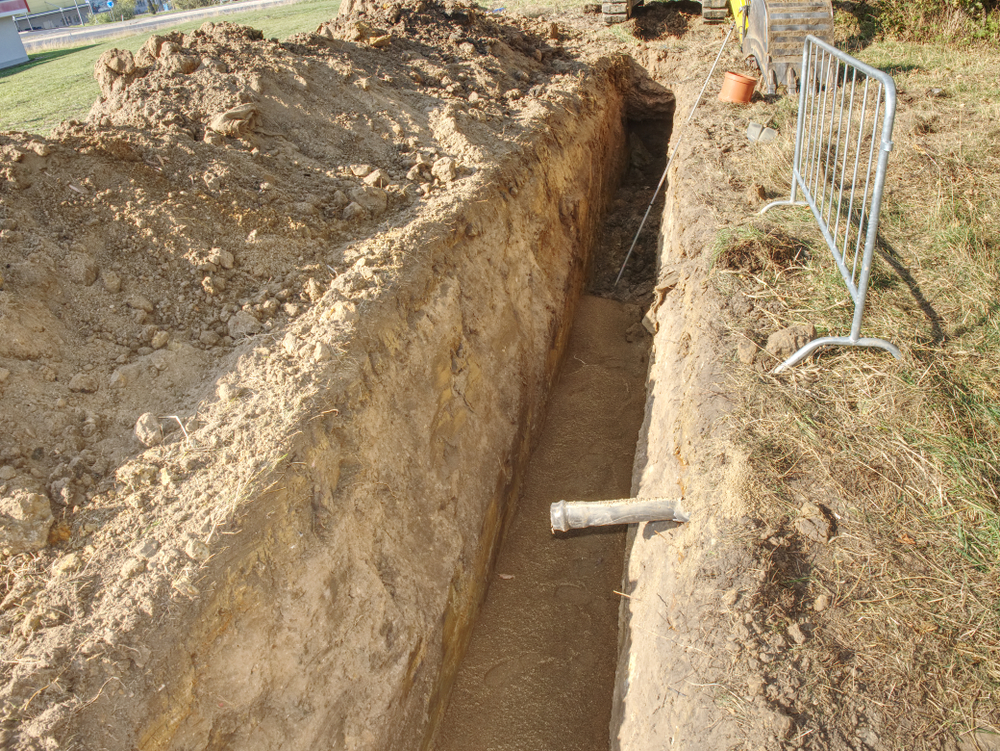
Most London homeowners assume the city is responsible for the sewer pipe once it crosses the property line. They are wrong. London operates under a rule that is unique in Ontario, and finding out about it mid-crisis can cost you tens of thousands of dollars. Here is everything you need to know before something goes wrong.
You bought your house. You pay your property taxes. You maintain the lawn, the roof, the furnace. You figure the city takes care of what is underground.
That assumption is reasonable. It is also wrong in London, Ontario. And the moment you find out it is wrong is usually the worst possible moment to find out.
This post explains exactly how sewer line responsibility works in London, why it is different from almost every other city in the province, what the financial exposure looks like, and what you can do right now to protect yourself before something goes wrong underground.
The Standard Rule Across Ontario
In most Ontario municipalities, responsibility for the sewer line connecting your house to the city's main sewer is split at the property line. The city owns and maintains the section from the main sewer line in the street to your property line. You own and maintain the section from your property line to your house.
This is the arrangement most homeowners expect. It makes intuitive sense. The pipe on your land is your pipe. The pipe on city land is the city's pipe.
London does not follow this arrangement.
What London Does Instead
The City of London classifies the entire pipe connecting your home to the municipal sewer as a Private Drain Connection, or PDC. That includes the section on your private property, the section under the boulevard, the section under the sidewalk, and in many cases the section under the road itself, all the way to the point where it meets the city's main sewer line.
Under London's Drainage By-law (WM-4), the property owner is responsible for the maintenance, repair, and replacement of the full PDC. The city owns the main sewer line in the street. Everything connecting your house to that main line is yours.
This was not always the case. The classification was formalized and reinforced through a bylaw review process that concluded in 2019, when the City of London's Civic Works Committee recommended amendments to the Drainage By-law specifically addressing PDC policies and charges. The city's own engineering report from that review states plainly: "In London, the property owner is responsible for the maintenance and ultimately the cost to replace their building's PDC."
For a full breakdown of exactly how the PDC is defined, where it starts, where it ends, and what the boundary means in practice, read our dedicated guide: What Is a Private Drain Connection (PDC) in London, Ontario?
As far as most plumbers and contractors in the region know, London is the only municipality in Ontario that takes this position.
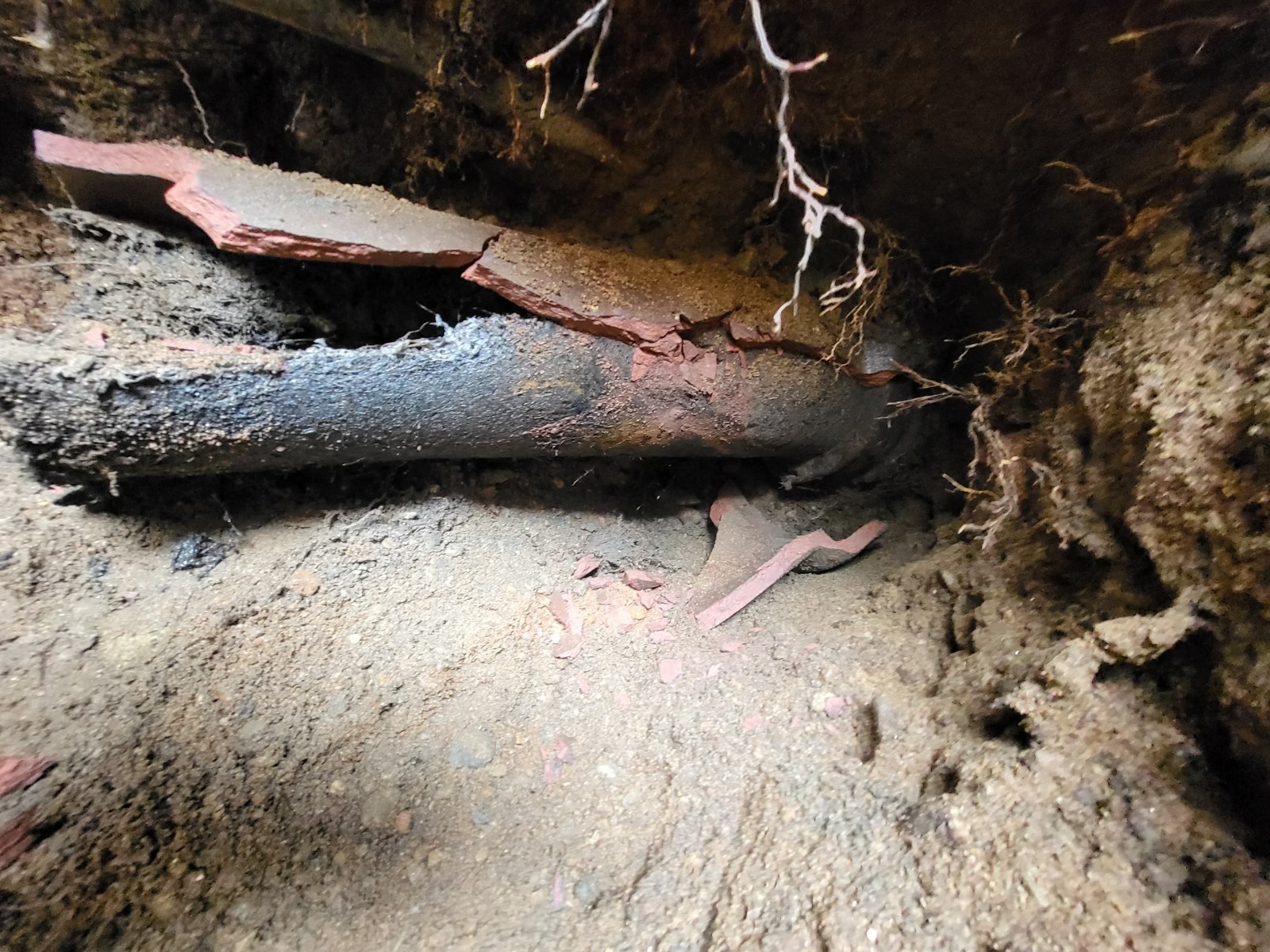
A collapsed clay sewer pipe exposed during excavation. In London, Ontario, the homeowner is responsible for this pipe from the foundation wall all the way to the city's main sewer line in the street.
Why This Matters More Than You Think
If you own a home in London that was built before 1980, there is a very good chance your sewer line is made of clay tile. Clay pipe was the standard material for residential sewer lines until plastic pipe became common in the 1980s. It is durable, but it has a finite lifespan, and a lot of it in London's established neighbourhoods is now 60, 70, or 80 years old.
Clay pipe fails in predictable ways. The joints between sections are not watertight, which means tree roots find them. Over decades, roots grow into the pipe and restrict flow. The pipe also shifts and settles with soil movement, creating low spots where waste accumulates. Eventually, sections crack or collapse entirely.
Not sure whether your drains are showing early warning signs? Read How to Tell If Your Sewer Line Is Broken for a plain-language guide to the symptoms London homeowners miss most often.
When that happens, the repair bill lands on you. Not the city. You.
Based on what London homeowners have reported in recent years, here is what that can look like:
| Repair Scenario |
Approximate Cost |
| Root cutting and drain cleaning (maintenance) |
$300 to $600 |
| Spot repair on private property (1 to 3 metre section) |
$2,500 to $5,000 |
| Trenchless pipe lining (full PDC length) |
$8,000 to $15,000 |
| Full PDC excavation and replacement (private section) |
$10,000 to $22,000 |
| City flat-fee PDC repair (city property section) |
$7,000 to $8,250 |
| Full PDC replacement including city coordination |
$15,000 to $28,000+ |
These are real numbers from real London homeowners, not national averages. For a deeper look at what drives costs up or down, read our post on sewer repair costs in London, Ontario.
The Part Under the Road Is Still Your Problem
This is the detail that shocks people the most.
When a plumber sends a camera down your sewer line and finds the collapse 20 metres from your house, past the property line, under the city boulevard and the sidewalk, you might reasonably assume the city takes it from there. In most Ontario cities, you would be right.
In London, you are still responsible for that section.
The city does offer a flat-fee program for the portion of the PDC that runs under city property. As of 2025, that fee is approximately $7,000 to $8,250, and it can be added to your property taxes and paid over ten years. The city sends their own crew to excavate through the road allowance and sidewalk, which they can do more efficiently than a private contractor because they already have the permits and the right of way.
But here is what that program is not: it is not the city taking responsibility for their portion of the pipe. It is the city offering to do the work for you at a fixed price. The financial obligation still belongs to you.
And the flat-fee program only covers the city property section. You still need a private contractor for the section from your foundation to the property line. The two repairs need to be coordinated so the connection is made properly.
The Moment Most Homeowners Find Out
Here is how this typically unfolds.
A homeowner in an older London, Ontario neighbourhood notices the basement floor drain is slow. They call a plumber. The plumber snakes the line, clears a root ball, charges a few hundred dollars, and leaves. Six months later, the drain is slow again. This repeats for a few years.
Then one day the drain does not just back up slowly. It backs up completely, and sewage comes up through the floor drain. Or the homeowner gets a sewer camera inspection done and the footage shows a section of pipe that has collapsed entirely.
At that point, the plumber explains the PDC rule. The homeowner learns for the first time that they are responsible for the full pipe. They receive a quote for $15,000 to $25,000. They call their insurance company and find out their policy does not cover underground pipe replacement. They call the city and learn about the flat-fee program, which helps with part of the cost but does not solve the whole problem.
All of this is happening while they cannot use the plumbing in their house.
This is not a rare scenario. It plays out regularly in London's older neighbourhoods, and it is almost always more expensive and more stressful than it needed to be because the homeowner did not know the rules until they were already in the middle of a crisis. If you are already in this situation right now, read our step-by-step guide: Your Sewer Pipe Collapsed in London, Ontario. Here's Exactly What to Do Next.
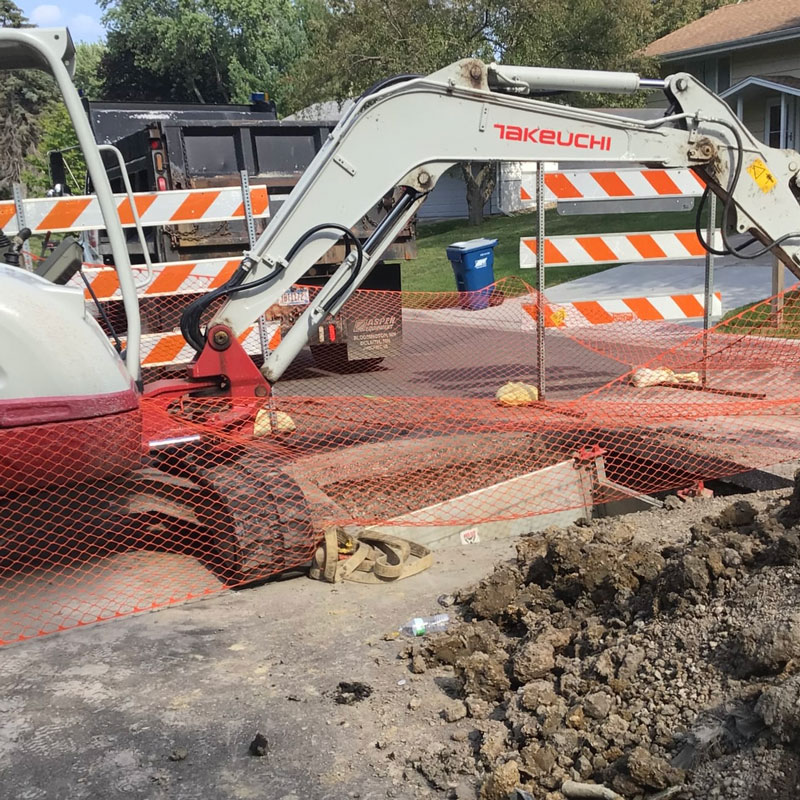
A sewer line replacement in progress. In London, Ontario, this kind of excavation is often required when a clay pipe PDC fails, and the cost falls entirely on the homeowner.
Does Home Insurance Cover This?
Sometimes. But not in the way most people hope.
Standard home insurance policies in Ontario do not cover the cost of repairing or replacing an underground sewer pipe. Pipe repair is considered a maintenance issue, and maintenance is the homeowner's responsibility.
Some policies include optional coverage for sewer backup, but that typically covers the damage caused by the backup inside your home, things like flooring, drywall, and contents, not the cost of fixing the pipe that caused the backup. If you have had a backup and are wondering what to do next, read Sewer Backup: What to Do in the First 24 Hours.
A smaller number of policies include coverage for sudden and accidental collapse of underground service lines. This is sometimes called service line coverage or equipment breakdown coverage. If you have this, it can significantly offset the cost of a repair. The key word is "sudden." A pipe that has been slowly deteriorating for years and finally fails is often not covered under this provision, even if the failure itself was sudden.
The practical advice is this: pull out your home insurance policy right now and read the section on water damage and underground service lines. Call your broker if you are not sure what is covered. Do this before anything happens, because once you are in a crisis, your options narrow considerably.
If you are in the process of buying a home in London, particularly an older home in an established neighbourhood, ask for a pre-purchase sewer inspection as part of your due diligence. A camera inspection before you close can reveal the condition of the PDC and give you negotiating leverage if the pipe needs work. This is not standard practice in most real estate transactions, but it should be.
What the City of London's Basement Flooding Grant Covers (and What It Does Not)
The City of London runs a Basement Flooding Grant Program that covers 90% of the cost of certain flood prevention measures, up to specified maximums. This program is worth knowing about, but it is important to understand what it does and does not cover.
The grant covers backwater valve installation (up to $1,800), sump pump installation with weeping tile disconnection (up to $4,000), battery backup systems for new sump pumps (up to $1,400), and storm private drain connections (up to $7,000). These are flood prevention devices, not sewer pipe repairs.
The grant does not cover the cost of repairing or replacing a collapsed or root-invaded PDC. It does not cover drain cleaning, pipe lining, or excavation for sewer line work.
If your basement is flooding because your PDC has collapsed, the grant program will not help you fix the pipe. It may help you install a backwater valve afterward to prevent future sewer backups, but the repair itself is out of pocket. For more on why basements flood and what actually fixes the problem, read Why Is My Basement Wet? The Most Common Causes in Ontario Homes.
There is one important rule about the grant program: you must apply and receive written approval before starting any work. Starting work before approval voids your eligibility completely. If you are considering any of the eligible flood prevention measures, contact the City's Sewer Engineering Division at sewers@london.ca before you hire anyone.
The Tree Root Problem in London's Older Neighbourhoods
If you live in Old South, Wortley Village, Old East Village, Old North, Byron, Westmount, or any of the established inner-city neighbourhoods, your PDC is almost certainly clay pipe. And clay pipe in a neighbourhood full of mature trees is a slow-motion problem. The same issue affects homeowners in nearby communities like Strathroy, St. Thomas, Dorchester, and Komoka, where older housing stock and mature tree canopies create the same conditions.
Tree roots are drawn to the moisture and nutrients in sewer pipes. Clay pipe joints are not sealed, which means roots find their way in through the gaps between sections. Once inside, they grow. They do not stop growing. A root mass that causes a minor slowdown today will cause a complete blockage in a year or two, and a collapse in five.
The city planted trees along boulevards throughout London's older neighbourhoods for decades. Many of those trees are now mature, with root systems that extend well past the boulevard and into private property, directly above and around the PDC routes of the homes on those streets.
This is not a reason to panic. It is a reason to know what is in your pipe. Our post on how often to clean your drains in London, Ontario explains the maintenance schedule that keeps root intrusion from becoming a collapse.
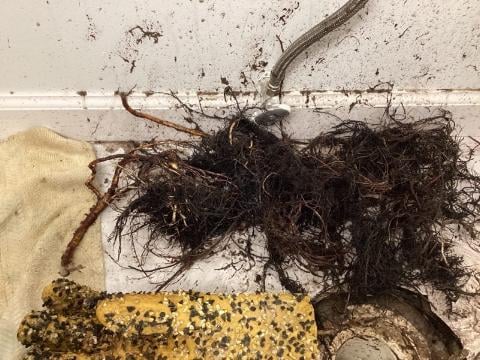
Tree roots extracted from a clay sewer pipe. Root intrusion is the most common cause of PDC problems in London's older neighbourhoods, and it is almost always worse than it looks from the outside.
What You Should Do Right Now
If you own a home in London that was built before 1985, here is a practical checklist.
Get a camera inspection if you have never had one. A free sewer video camera inspection shows you the current condition of your PDC: whether there is root intrusion, any cracks or offsets, how much useful life is likely left. At Discount Drain, we include a free camera inspection available at no charge. We show you the footage on the spot so you understand exactly what you are looking at.
Know where your PDC runs. Contact the City of London's geomatics department and request a sewer schematic for your address. It is free. It gives you a map showing where your PDC runs from your house to the main line, which is useful both for understanding your exposure and for planning any future repair work.
Review your home insurance policy. Find out whether you have sewer backup coverage and whether you have any service line coverage. If you do not, consider whether adding it makes sense given the age of your home.
Do not ignore slow drains. A drain that is slow throughout the house, not just in one fixture, is often an early sign of root intrusion or a developing blockage in the main line. Addressing it early, with a drain cleaning and root cutting if needed, costs a few hundred dollars. Waiting until it collapses costs tens of thousands. Read How Often Should You Clean Your Drains? for the maintenance schedule that makes sense for older London homes.
If you are buying an older London home, get a camera inspection before you close. A pre-purchase sewer inspection reveals the condition of the PDC and gives you information you need before you take on the responsibility for that pipe. This applies whether you are buying in London, Woodstock, Ingersoll, Stratford, or anywhere else in Southwestern Ontario where older housing stock is common.
The Honest Bottom Line
London's PDC rule is not going to change. It is established in the city's bylaws and it has been the policy for years. The city is not going to start absorbing the cost of sewer repair and installation on private property.
What you can control is how prepared you are. A homeowner who knows about the PDC rule, knows the condition of their pipe, and has a plan for maintenance is in a completely different position than one who finds out about all of this when sewage is coming up through the basement floor drain.
We have been doing this work in London and Southwestern Ontario since 1970. We have seen what happens when people know about these issues in advance and what happens when they do not. The difference in cost, stress, and disruption is significant.
If you want to know the condition of your sewer line, request a free quote or call us at 519-451-8342. We will send someone out, put a camera down the line, show you the footage, and tell you honestly what you are dealing with. No pressure. No obligation. Just information.
That is the best investment you can make in a house that was built before 1980.
Frequently Asked Questions
Does the City of London own any part of my sewer line?
No. Under London's PDC classification, the entire pipe from your foundation wall to the city's main sewer line is your responsibility. The city owns the main line in the street, but not the connection to your house.
What is the city's flat-fee program for PDC repairs?
When a PDC repair requires work on city property, the city offers to complete that portion for a flat fee of approximately $7,000 to $8,250 (as of 2025). This can be added to your property taxes and paid over ten years. It covers only the city property section. You are still responsible for the private property section.
Can I hire my own contractor to do the full PDC repair including the city property section?
In some cases, yes, if the contractor has the required permits and equipment to work in the road allowance. For many homeowners, the city's flat-fee program is the more practical option for the city property section. Discuss this with your contractor or contact us for an honest assessment.
Will the city come out to inspect for free?
Yes. Call 519-661-4570 to report a sewer issue. The city will inspect the municipal main line at no charge and confirm whether the problem is on their side or yours.
How long does a PDC repair take?
A trenchless lining job typically takes one to two days. A full excavation and replacement can take three to five days. If city coordination is required for the city property section, add time for scheduling.
What is the best way to prevent PDC problems?
Regular sewer camera inspections every five to seven years for homes built before 1985, combined with root cutting as needed, is the most cost-effective approach. Catching problems early gives you options. Waiting until a collapse removes most of them.
Does the City of London's Basement Flooding Grant cover PDC repairs?
No. The grant covers flood prevention devices like backwater valves and sump pumps. It does not cover the cost of repairing or replacing a sewer pipe. See our residential services page for what Discount Drain covers.
Related reading: What Is a Private Drain Connection (PDC) in London, Ontario? | Your Sewer Pipe Collapsed in London, Ontario. Here's Exactly What to Do Next. | Trenchless vs. Traditional Sewer Repair: What Ontario Homeowners Need to Know