The toilet may look normal. The tank may be full. You may have had the valve installed years ago precisely to avoid worrying about a flooded basement. It is understandable to expect the plumbing to carry on working.
While the valve is holding back sewage, the household needs to stop sending water towards it. London's official flooding guidance tells residents not to shower, flush the toilet or use household plumbing until the valve is open again.1
That instruction applies to a valve closed against backflow. Some valve designs rest closed during ordinary use and open to let wastewater out. A closed-looking flap alone is not enough to diagnose an emergency. The model and operating condition matter.2
Why a toilet flush can back up behind a closed valve
A sanitary backwater valve sits in a wastewater pipe. Under normal conditions, wastewater from the fixtures it serves can leave the house. When sewage tries to flow backwards, the valve's closure mechanism blocks that route.1 2
On a normally open model, such as the Mainline Fullport, rising reverse-flow water lifts a gate. The gate closes across the pipe. While it is closed, water approaching from the house side cannot continue through that same opening.3 4
A toilet flush still sends the contents of the bowl and tank into the home's drain. If those drains run through the closed valve, that water stays on the house side. More water from showers, sinks or appliances can add to it. Wastewater may eventually escape through a low connected fixture, such as a basement shower or floor drain.4
The exact overflow point depends on the plumbing layout. Nobody can look at an upstairs toilet and promise that one flush will fit safely inside the pipes. The amount of available space is unknown, and it may already contain backed-up water.
This is why a functioning valve and a basement backup can exist at the same time. The valve may be blocking incoming sewage while water used inside the house fills the drains behind it. The Government of Canada describes the risk of using excess water during closure as a potential “self-flood.”2
A full tank does not make flushing safe. Turning off the fresh-water supply does not empty the tank or remove wastewater already in the drains. An improvised bucket flush also sends water into the affected sewer route.
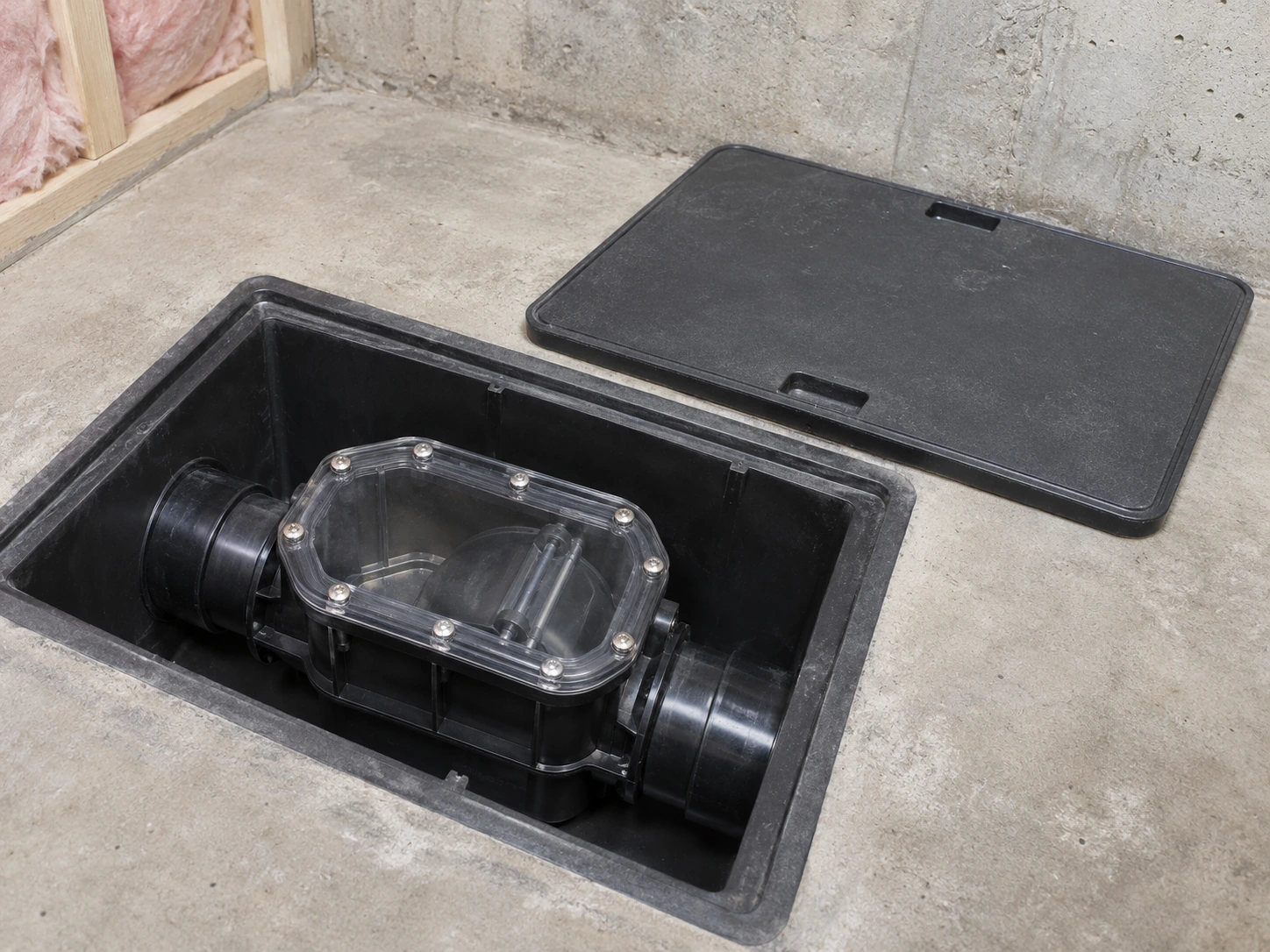
The outer access cover is set aside while the valve's clear lid remains secured. Keep this access area reachable.
What to do while the valve is holding back sewage
If a backflow closure is confirmed, stop using the affected plumbing. If you cannot identify the connections, follow London's household-wide precaution until a plumber can clarify the layout.1
Start by telling everyone in the home. Someone upstairs may have no idea that the valve has engaged. Let visitors know as well. If another household shares the drainage system, make sure they know there is a problem before they start laundry or use the shower.
For the fixtures and appliances connected to the affected drain:
- Do not flush toilets or start a shower or bath.
- Avoid running sinks or emptying stored water into them.
- Do not start the dishwasher or washing machine.
- Check the instructions for any appliance already running before choosing a pause or stop control. Avoid a control that sends the machine's water into the drain.
- Consider any known automatic wastewater discharge, such as a scheduled water-softener regeneration. Get advice about safely pausing it rather than changing settings you do not understand.
The purpose is to stop additional wastewater entering the restricted route. Do not treat closing the home's incoming water supply as proof that the drain is clear. Appliances and toilet tanks may already hold water that can still be discharged.
An appliance's controls vary by model. If you do not know how to pause it without initiating a drain cycle, tell the technician what is running and follow the appliance instructions. Do not repeatedly restart or cancel programmes to see what happens.
Bathroom access can be difficult when a closure lasts. Arrange to use a toilet that is away from the affected drainage system rather than assuming another bathroom in the same house is separate. If you cannot confirm a safe arrangement, contact Discount Drain for advice about the next step.
You do not need to keep this whole list in your head during a stressful evening. Before the next storm, put a short note near the laundry controls: “Backwater valve alarm or confirmed closure: stop household water use and check the response plan.” The note should explain your particular installation, not rely on a generic alarm meaning.
Can you use the upstairs toilet instead
Do not assume that an upstairs bathroom bypasses the valve.
If the valve is installed on the main wastewater route downstream of the home's fixture connections, upstairs toilets and sinks can send water through it too. Using them can fill the same house-side drainage system that serves the basement.2 4
Other installations use a valve on a branch serving selected fixtures. In that arrangement, some plumbing may have a separate route. The location of the basement access hatch does not reveal every pipe connection, and the height of the bathroom does not settle the question.
Ask the installer to identify the fixtures that drain through the valve. Useful records include a marked plumbing drawing, an installation invoice with the valve model, and photographs taken before the pipe was covered. Have any later basement bathroom or laundry alterations checked against that arrangement.
Until the route is known, pause household plumbing during a suspected active closure. A call that establishes which drains are affected is safer than an upstairs test flush.
An installation can also have more than one valve or specialised pumping equipment. Those systems need advice specific to their layout. This guide cannot tell you that a particular fixture is safe without that information.
How to check the valve without opening the sewer
Only approach the valve if the area is safe and dry. Do not enter a flooded basement to inspect it if water has contacted electrical outlets, heating equipment, the electrical panel or other electrical equipment. London's flood guidance warns against entering under those conditions.1
If you know where the valve is, separate two things in your mind: the outer floor access cover and the valve's sealed lid or cleanout cap. Reaching an access box is not permission to unscrew the fitting that contains wastewater.
Some models have a transparent lid that allows a visual inspection while the valve remains sealed. Mainline specifically provides this feature on its Fullport valve. If yours has one, and you can reach it safely, look through the intact cover. Use the model's instructions to understand the position you are seeing.2 3
Leave the sealed valve cover and cleanout cap in place during an active backup. Do not remove the gate, reach into the fitting or force the flap open to restore drainage. Those actions can expose you to wastewater and interfere with the protection the valve is providing. Cap removal and internal cleaning belong to an appropriate maintenance procedure, not an improvised storm response.3 5
If the cover is opaque, buried beneath flooring, inaccessible or impossible to inspect safely, keep the water-use precaution in place and contact a plumber. Do not cut into the floor or open a cap to find out whether the drain is under pressure.
For a normally open Fullport-type valve, the open resting position and the backflow-closed position are different. A normally closed product, such as RectorSeal's Clean Check, works differently: its flapper rests closed and opens for outward discharge under normal conditions.2 5
That difference is enough to make a one-size-fits-all “check whether the flap is down” instruction unreliable. Identify the model before using its appearance as an all-clear.
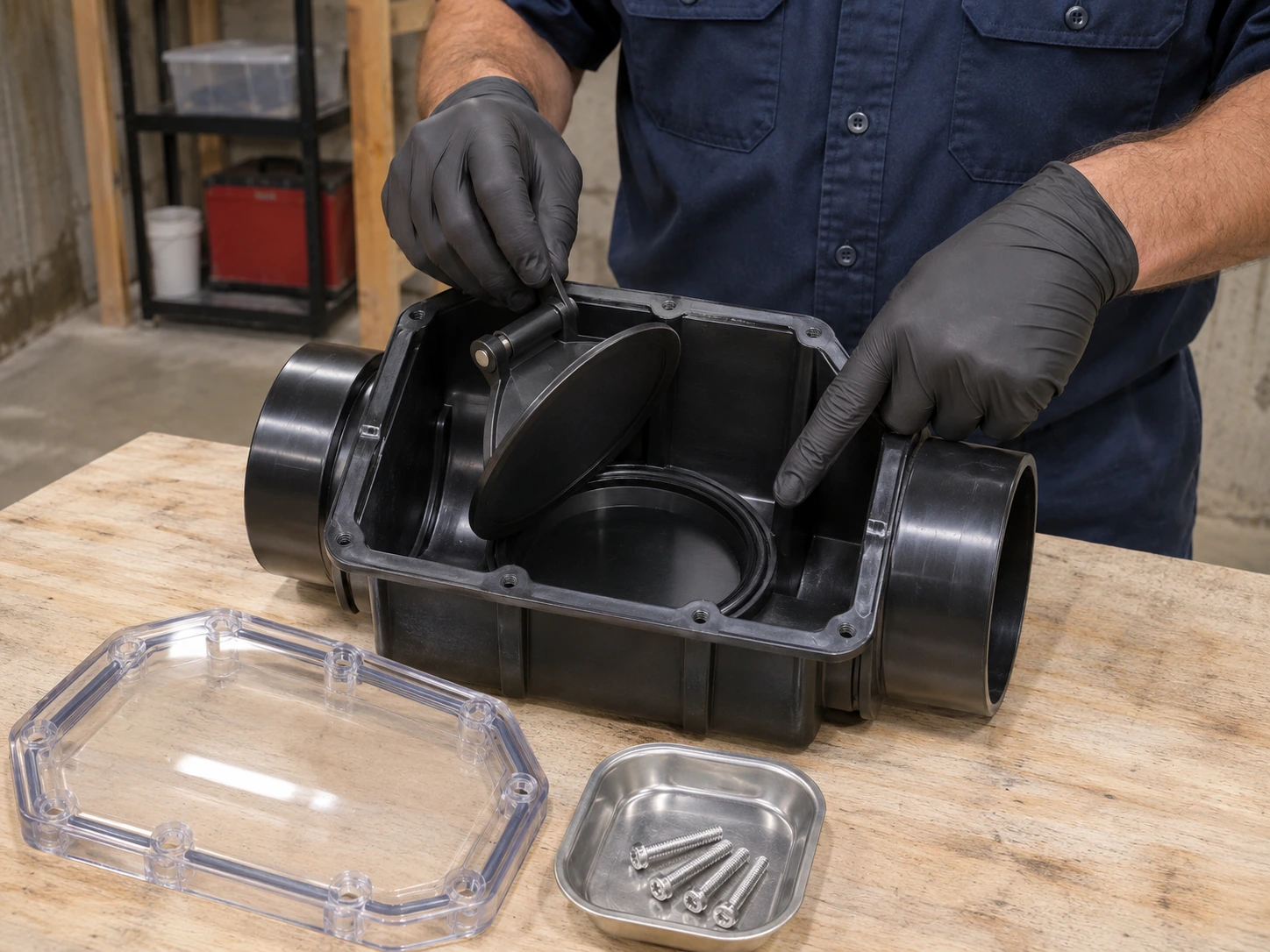
A workbench demonstration exposes the flap and sealing area. Keep the sealed lid in place on a connected valve during an active backup.
What a backwater valve alarm tells you
Treat an unfamiliar sewer alarm as a warning. Pause wastewater use while you check the instructions or get professional advice. Do not assume that every sound proves the flap has closed, or that silence proves the sewer can accept water.
Different alarms detect different conditions. Mainline's ML9V-BW flood alarm uses a float sensor activated by backed-up water. The Sentinel 7141 system detects increased pressure in a cleanout tee. Its manufacturer describes several possible causes, including a drainage blockage, storm flooding and street-sewer backflow.6 7
Neither description makes the alarm a diagnosis of a failed municipal sewer. The warning needs to be interpreted alongside the installation and what is happening in the drains.
Your system may also have its own battery, fault or test indications. Keep its instructions with the household response plan. If the sound is unfamiliar, do not dismiss it as a battery warning or silence it and continue using the plumbing.
An alarm battery powers the alarm equipment where specified. A normally open, float-assisted valve can close mechanically as backflow rises.3 6
If you have no alarm, do not wait for one to warn you. London's guidance includes checking the valve during rain where that can be done safely. It does not say a home without an alarm is protected from closure or a sewer backup.1
When you can use the plumbing again
There is no universal ten-minute, one-hour or overnight waiting period.
London tells residents to wait until the valve is open again before using household plumbing. For a normally open, gravity-operated gate, reopening should occur when the backflow condition ends, provided the device is functioning properly.1 3 4
The end of the rain does not confirm that the sewer has returned to normal. Neither does the disappearance of an alarm, by itself. The operating condition of the valve and drain needs to be clear.
Follow the installed model's instructions for confirming normal operation. If a normally open valve remains closed, the alarm persists, wastewater rises or you cannot inspect the device safely, keep water use paused and get professional help. Continuing backflow, a valve problem and another drainage restriction cannot be separated by a guess from the bathroom.
For a normally closed model, look for confirmation that the system has returned to normal operation, not an open resting flap that the product is not designed to have.2 5
Do not use a toilet flush as the test of whether an uncertain drain has recovered. That flush adds water to the system before you know it can leave. There is no supported allowance for a small flush, a half-full tank or “one more before bed.”
When you contact a technician, describe the warning or valve position you observed, whether any water is coming up, and which appliances were running. Those details can help establish the next safe step without asking you to reproduce the problem.
If you already flushed or the drains are backing up
If someone flushed before learning about the closure, stop further water use. Do not keep flushing to see whether the toilet will clear. The earlier flush does not tell you how much capacity remains in the pipe or whether another discharge will stay contained.
From a safe, dry position, note any new gurgling, rising water or discharge at lower fixtures. Record the time and which appliance or fixture was used. If wastewater is already coming out, keep people and pets away and call for help. Sewage-contaminated floodwater requires special precautions.8
For a drain or sewer emergency, call Discount Drain at 519-451-8342. Tell us you have a backwater valve, whether an alarm is sounding, and where the water is appearing. Do not enter a hazardous basement to collect more information before calling.
A valve closure does not explain every backup. A blocked drain, damaged pipe or another restriction may need investigation. A sewer camera inspection can help assess the pipe where access and conditions allow. It does not replace identifying the valve model and the fixtures connected to it.
Likewise, a drain-cleaning recommendation should follow the diagnosis. The presence of an alarm or a closed gate alone does not establish that hydro jetting, snaking or a new valve will solve the problem.
If sewage is coming out of an outside access fitting, use our London sewer-cleanout first-response guide. For water already entering through a basement fixture, our sewer-backup emergency guide covers the broader response. Keep the electrical and contamination hazards separate from the question of when you can flush again.
What to arrange before the next heavy rain
Use a calm, dry day to understand the installation. Start with the valve's model and manufacturer's instructions. Know where the access cover is, what the normal resting position looks like, and which fixtures discharge through it.
Have the valve inspected and maintained according to its specific manual. London's guidance puts regular cleaning responsibility on the homeowner and directs residents to the manufacturer's recommendations.1 Mainline's maintenance instructions include checking for debris and free gate movement. Other products have different procedures and intervals.3 5
Do not pour boiling water or drain chemicals into the fitting as an improvised repair. Do not turn routine cleaning instructions into a procedure to try while the sewer is backing up. Arrange suitable professional maintenance before an event makes access difficult.
If you bought the home with a valve already installed, ask for any installation and maintenance records. An access cover under a rug does not show when the device was last serviced or how a later bathroom renovation connects to it.
London also says weeping tiles connected to the sanitary sewer must be disconnected before a backwater valve is installed.1 If an older home's arrangement is unclear, have the drainage connections assessed. Our weeping-tile guide explains that part of the system without treating it as the same pipe that carries toilet wastewater.
A running sump pump does not confirm that the sanitary sewer is accepting flow. Sump drainage and sanitary wastewater serve different purposes. Do not switch off a sump pump as a blanket response to a backwater-valve warning. Ask a professional about any unusual or unknown discharge arrangement.1
Finally, a sanitary valve cannot stop every route of basement water entry. Foundation leaks and surface water need their own diagnosis. Our guide to basement flooding that happens only when it rains in London helps separate those causes. This article is concerned with household wastewater during a backflow closure.
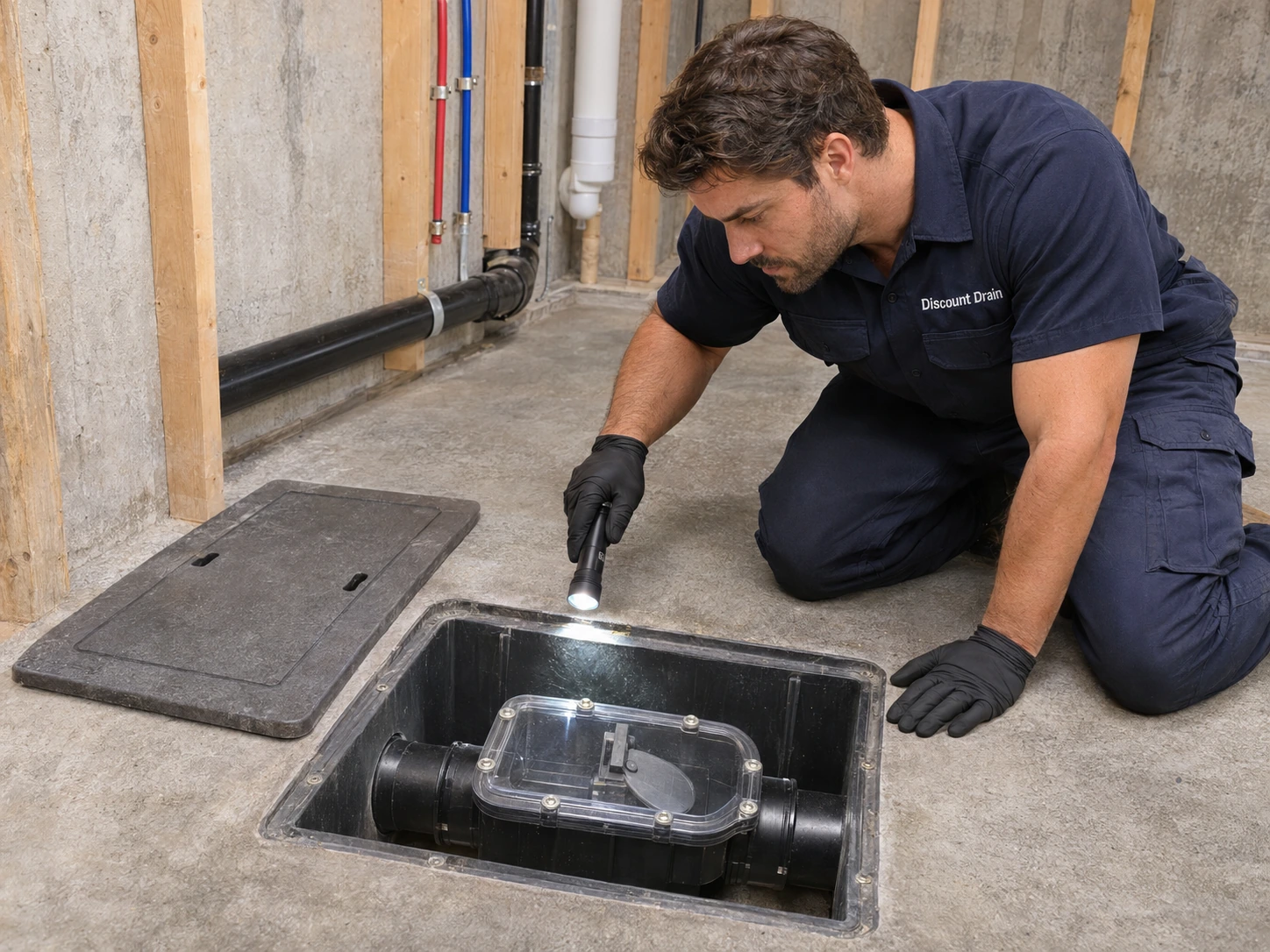
A transparent lid can allow a visual check without opening the valve. Approach only when the surrounding area is safe and dry.
Questions London homeowners ask
Can I flush just once if the toilet bowl looks normal?
Do not rely on the bowl's appearance. A flush sends water farther into the drain, where the backwater valve may be blocking the exit. London's instruction is to stop plumbing use while the valve is closed against a backup, not to ration a safe number of flushes.1
Can I use the sink for a quick hand wash?
If that sink drains through the affected valve, its water adds to the restricted pipe. Follow the same pause instruction. Arrange bathroom and hygiene access away from the affected drain rather than assuming a small discharge is safe.
Does every closed flap mean the sewer is backing up?
No. Some backwater valves normally rest closed and open for outward discharge. Identify the model and its normal operating state before interpreting flap position. If drainage is abnormal or the state is uncertain, pause wastewater use and have it assessed.2 5
Will a working valve always prevent basement flooding?
No. Protection depends on the valve's condition and the pipes connected to it. Household water can back up behind an engaged valve, and foundation or surface water can enter by another route.1 4
Is a backwater valve the same as the check valve on my sump pump?
They perform different jobs. A sanitary backwater valve protects a wastewater route against reverse flow. Sump equipment handles water collected by the sump system. A working sump pump does not establish that toilet wastewater can pass an engaged sanitary valve.1
Will insurance cover a backup even if I have a valve?
The valve's presence does not determine your policy's coverage. Check the policy and speak with your insurer about the event. Our London sewer-backup and service-line insurance guide explains the separate coverage questions without promising a claim outcome.
Need help with a closed valve or uncertain drainage
If water is rising, the warning persists or you cannot confirm safe drainage, call Discount Drain at 519-451-8342. Keep household wastewater use paused and describe what you have observed.
For a non-emergency assessment, request a free quote. Quote requests are handled during business hours. For an emergency, call the number rather than waiting for a form response.
References
- City of London: Flooding and backwater-valve operating guidance
- Government of Canada: Backwater valves
- Mainline: Fullport Backwater Valve
- Utilities Kingston: Backwater sanitary valves
- RectorSeal: Clean Check product and maintenance documents
- Mainline: ML9V-BW flood alarm brochure
- Jay R. Smith: Sentinel 7141 alarm system
- Health Canada: Flood cleanup and contaminated water